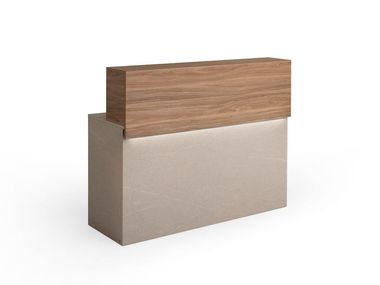
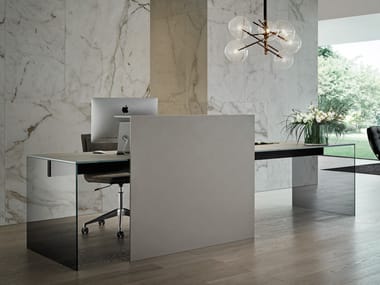
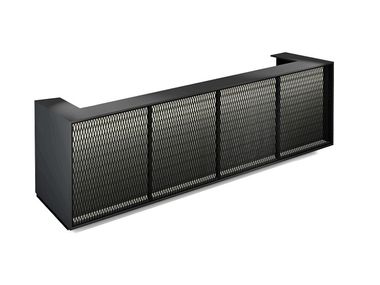
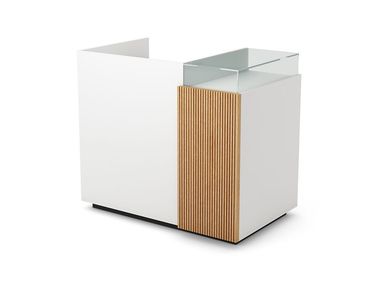
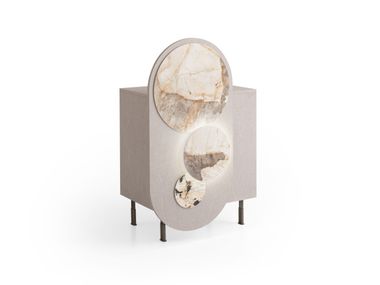
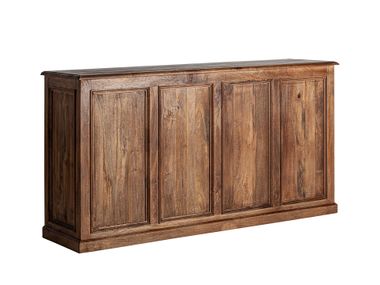
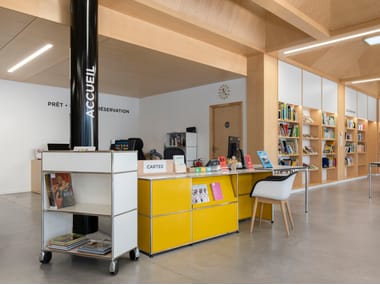
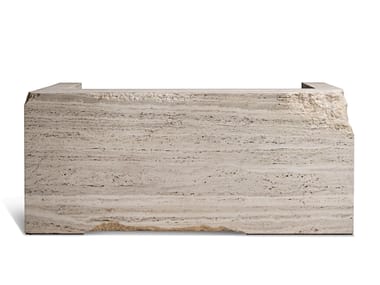
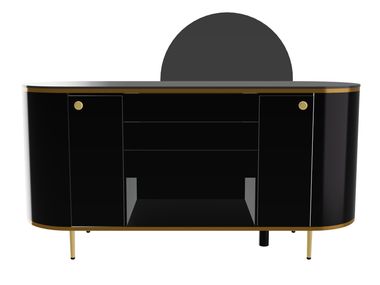
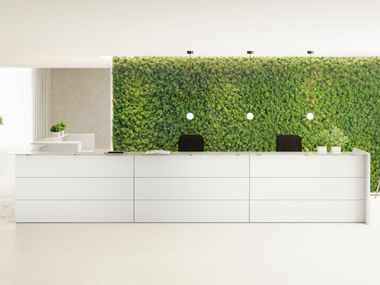
In addition to reflecting a company's identity and values, the reception area must ensure an efficient welcome, conveying order, cleanliness, and professionalism. The reception desk therefore plays a strategic role, both functionally and communicatively, and must meet clearly defined design criteria. The two-level configuration is the most common typology: a lower internal work surface reserved for the staff is paired with an upper shelf—also known as a courtesy top—dedicated to the public. This solution allows operational equipment to be concealed while maintaining effective visual and gestural interaction.
Some models include an interview top at operator height, designed for tasks requiring more direct interactions, such as signing or reviewing documents. In such cases, seating for visitors must also be provided. The internal area of the desk should be designed according to principles of ergonomics and productivity: the operator must have an appropriate work chair, a computer, telephone, possibly a fax machine and printer, along with storage systems for stationery and documents. A well-designed reception counter combines representative aesthetics with operational efficiency.
Selecting a reception desk requires consideration of various parameters: space configuration, number of staff, desired level of privacy, expected visitor flow, and the specific functions of the station. In cases where the operator's role is limited to welcoming guests and filtering calls, basic equipment will suffice. However, if the workstation also includes secretarial tasks, document management, or operational front-office duties, it is necessary to integrate storage elements (drawers, cabinets, shelving) coordinated with the style and materials of the main desk. Finally, the inclusion of cable management systems and technical accessories is essential for maintaining an organized and efficient work environment.
Despite the functional constraints of reception desks, the market offers a wide range of modular variants that allow for high compositional flexibility. Modular reception desks can be adapted to specific spatial needs, enabling linear, curved, L-shaped, U-shaped, or S-shaped configurations. The use of curved modules helps reduce the "barrier" effect between staff and visitors, fostering a more fluid and welcoming spatial perception. In contrast, linear solutions are better suited to formal and institutional settings. Modular design also allows for optimal management of wiring and systems: it is possible to integrate cable channels, grommets, and LED lighting systems to highlight the structure or create visual effects.
The formal and material language of the reception desk contributes to defining the company's image. Finishes—even more than form—convey values such as reliability, innovation, elegance, or sustainability. A wood reception desk, for example, communicates tradition and trustworthiness; technical materials like Solid Surface, on the other hand, allow the creation of sculptural volumes with continuous surfaces that are easily customized in color and texture to reflect brand identity. Glass, often used for the courtesy top, adds transparency and lightness, helping to brighten spaces lacking natural light. More advanced versions include recessed or exposed LED strips, placed at the base or along the profile of the desk, to enhance the shape and improve the visual experience. In some cases, the company logo can be integrated and backlit on the front panel for immediate and professional identification.