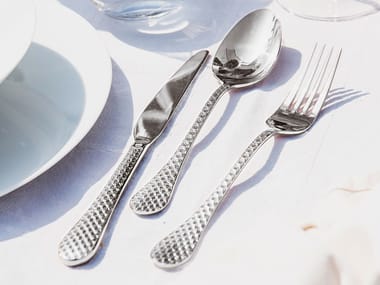
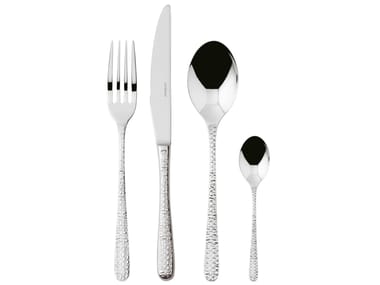
Sambonet is a historic name in Italian industry. A noted family of goldsmiths began producing silverware in 1856. Over time, the company expanded its catalog to include complete sets of
stainless steel cutlery and later
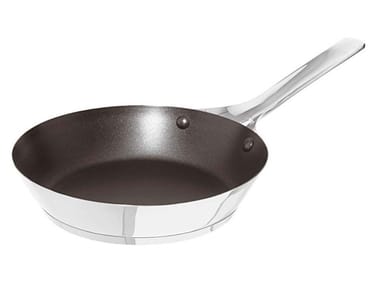
kitchen and
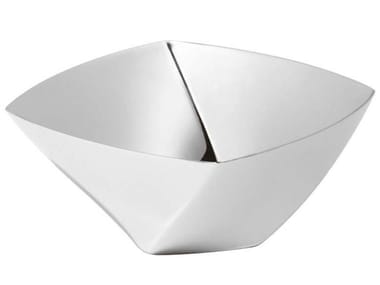
tableware. Sambonet manufactures a wide-ranging assortment of tableware and accessories for the Italian and international markets. Today, many Sambonet products are considered watersheds of Made-in-Italy design, and it is no coincidence that some are in museum collections like MoMa in New York. In 2009, Sambonet, since 1997 part of the Sambonet Paderno Industrie S.p.A Group and owned by brothers Franco and Pierluigi Coppo, acquired the German porcelain brand Rosenthal, and then the Bavarian company Arzberg in 2013, followed by the French porcelain company Ercuis & Raynaud in 2015. Still produced in the Orfegno factory between Novara and Vercelli, Sambonet's cutlery, cookware and tableware are intended for the home and the hospitality sector.
The history of Sambonet: from aristocratic homes to design museums
The Sambonet story began in 1856, when Giuseppe Sambonet founded a company specializing in the production of silver cutlery for noble families like the House of Savoy, for which it became the official supplier in 1900. In 1932, Sambonet was the first Italian company to create an industrial-scale factory for galvanic silver plating, an electrolytic process to coat objects with a thin layer of silver to make them aesthetically pleasing and corrosion-resistant. Five years later, Sambonet innovated the production of stainless steel cutlery using a new silver-plating process that guaranteed higher resistance to sulphurization. Starting in 1947, the use of unique in-house technologies applied to the production of stainless steel knives and blades allowed the company to conquer the international market. The Piedmont company's modern identity was closely linked to the figure of Roberto Sambonet, grandson of the painter, decorator, and set designer Francesco Bosso from Vercelli, who encountered artists like Lina Bo Bardi, Alvar Aalto and Constantin Brâncuşi during his career. Sambonet designed iconic pieces like the round-oval plate (1955, Compasso d'Oro 1956);
Pesciera (1957, Compasso d'Oro 1970), Longilinea (1957) and Metron (1960, Compasso d'Oro 1970) cutlery; Electrogas cookware set (1960, Compasso d'Oro 1970); the Center line series of stackable containers (1963-65). Other historic figures who worked with Sambonet are Anna Castelli Ferrieri, author of
Hannah cutlery, which won the Compasso d'Oro in 1994;
Gio Ponti, who created the flatware bearing his name, in production since 1932; and Rodolfo Dordoni, designer of the
S-Pot cookware line (2004).
Sambonet design on the table and in the kitchen
The Sambonet catalog still counts on timeless flatware sets like the Gio Ponti Collection, or Hannah, to which new pieces have been added over time and whose vintage effect is obtained by means of a series of abrasive industrial processes that give the surfaces a deliberately "worn" effect. Black, Copper, Gold and Champagne colored cutlery is made by a PVD process that gives the objects their precious colors and shades. And then, of course, there is tried-and-true Sambonet silver plated flatware. Sambonet produces a rich range of cookware -
pots,
frying pans, woks,
accessories and
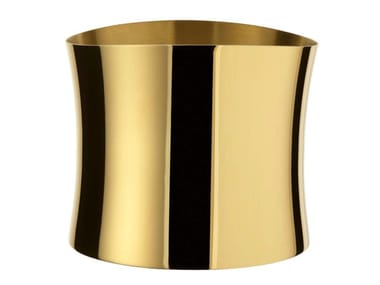
knives - in different materials: vintage-effect stainless steel, enameled cast iron, terracotta and aluminum. In addition to the famous Sambonet fishbowl, an object with essential lines that transforms steel into a precious material by relinquishing decoration and playing with its shine, the company produces stainless steel, silver-plated, glass and ceramic tableware that can grace any table from the formally classic to the most contemporary and informal.